The return of light
In Florence, the liturgy of the new fire continues to mark one of the most intense moments of the Easter season. Following it closely—as we have been able to do in recent years—gives a clear sense of how alive this rite still is, deeply rooted and shared in the memory of the city. At its center are the three fire-striking stones of the Holy Sepulchre, kept in the Church of Saints Apostles and Saint Biagio in Piazza del Limbo and venerated as relics linked to the Passion and Resurrection of Christ. According to tradition, they were brought to Florence at the end of the 11th century by the crusader Pazzino de’ Pazzi, as recognition for his valor during the First Crusade. From that gesture the rite of the sacred fire takes shape: the striking of the stones ignites the Easter flame, which is then carried through the streets of the city.
Families come out to meet the cart, receive the fire, and bring it into their homes as a tangible sign of Easter. It is from this custom that the Scoppio del Carro (Explosion of the Cart) originated, still today one of the most anticipated and widely attended moments of Florentine Easter. On the evening of Holy Saturday, these ancient fragments cross the city in procession toward the Cathedral of Santa Maria del Fiore, together with the fire-bearing brazier, the Gonfalon of the City, and a representation of the Historical Parade of the Florentine Republic. The route cuts through the historic center and reaches the forecourt of the Duomo, where the Archbishop kindles, from the spark of the stones, the new fire destined for the Easter Vigil. From that flame the Paschal candle is lit, a sign of the Risen Christ. A burning ember is kept until Easter morning, when, at the singing of the Gloria, the Colombina comes to life and initiates the Explosion of the Cart, radiating the new Easter joy throughout the city.
Safeguarding the sacred, making memory visible: the project of the new reliquary case
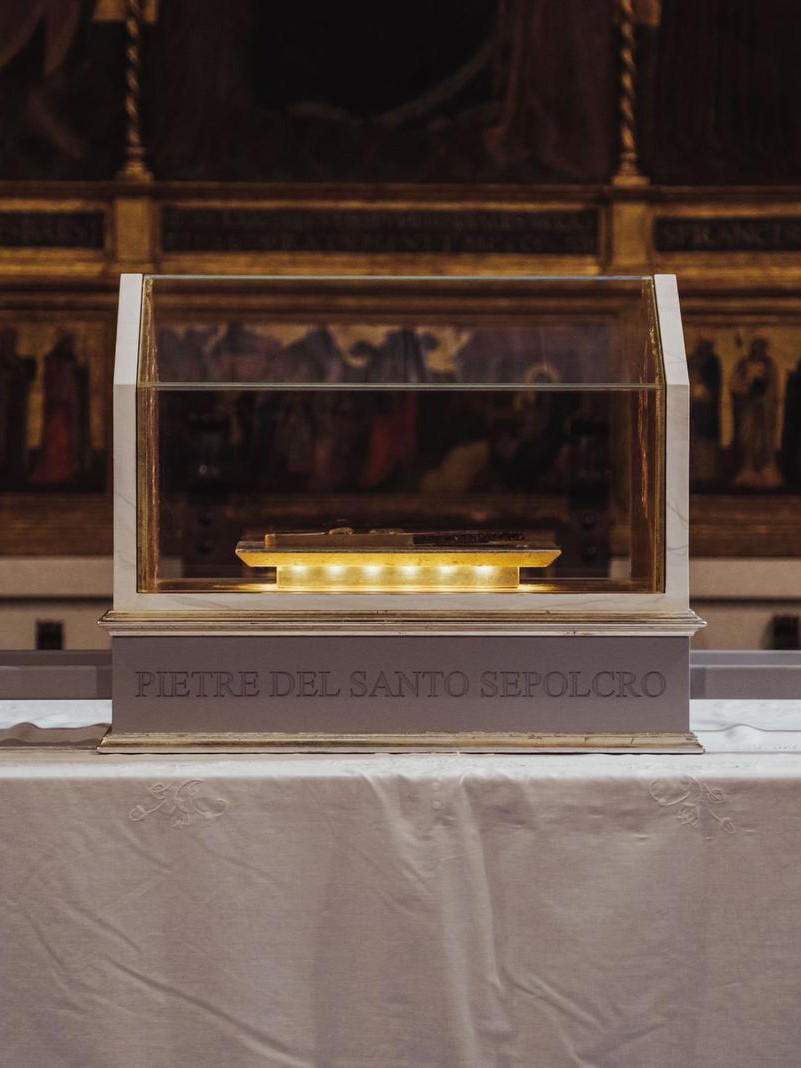
It was precisely by being immersed in this rite, observing closely its gestures and devotion, that over time the need arose to provide the stones with a more appropriate setting. From this shared perspective, the project for a new housing took shape, developed together with the parish of Saints Apostles and Biagio and the Diocese of Florence. The goal was to bring back into view the relics that had long remained in the sacristy, creating a case that could safely present them for public veneration.
The stones arrived at the Church of Saints Apostles in the 18th century, when the parish of Saint Biagio—then located near the present Palazzo di Parte Guelfa—was suppressed and the two dedications were united. One of the three stones was lost and later found in the countryside of the Florentine hills by Deacon Bicchi, from the Office of Cultural Heritage and Sacred Art of the Diocese of Florence, in a story with almost investigative overtones. An episode that strengthened their value, not only historically but also deeply symbolically.
Considered “contact relics,” because according to tradition they touched the Holy Sepulchre, the stones were until recently kept in a deteriorated display case dating back to the 1950s. From this came the idea of a new structure: to protect them while also making them visible. To restore presence. To restore relationship.
A symbolic dweeling for the relics: material, sign and the future of a work in progess
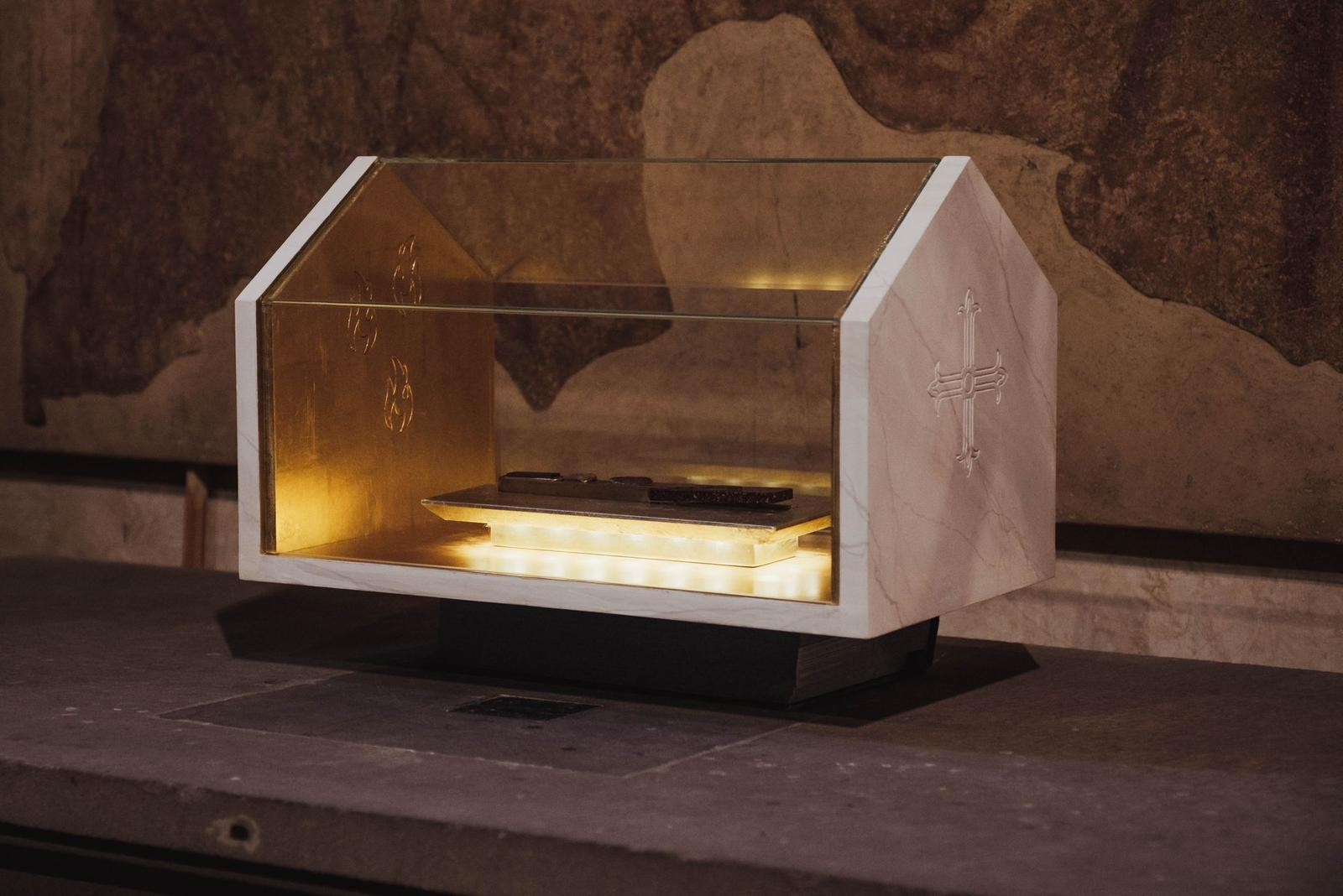
In following the development of the project, we sought to translate these needs into a form capable of holding together time and meaning. The new reliquary structure, conceived as a “house-tomb,” is an essential volume that both contains and opens, evoking the materiality of death and the promise of resurrection. The form—simple yet designed according to the golden ratio—suggests a house, a familiar place to be traversed and embraced with the gaze.
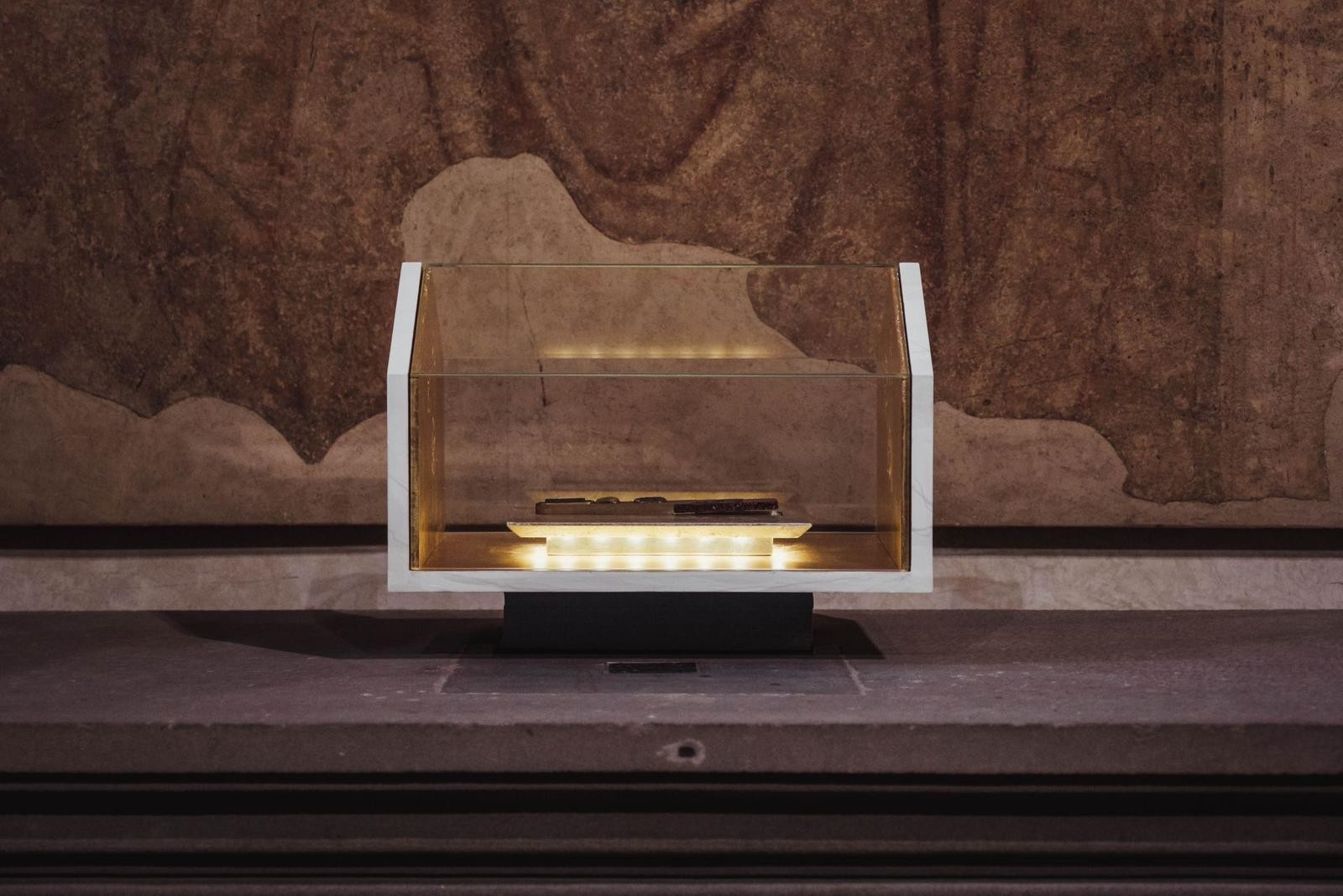
The structure is conceived as a monolithic block carved by subtraction in white statuary marble—a material deeply rooted in the Tuscan tradition of tombs—while crystal allows a direct view of the relics and symbolizes the divine light that breaks through darkness. Inside, the case is gold-plated, reflecting light and glowing like the Easter fire.
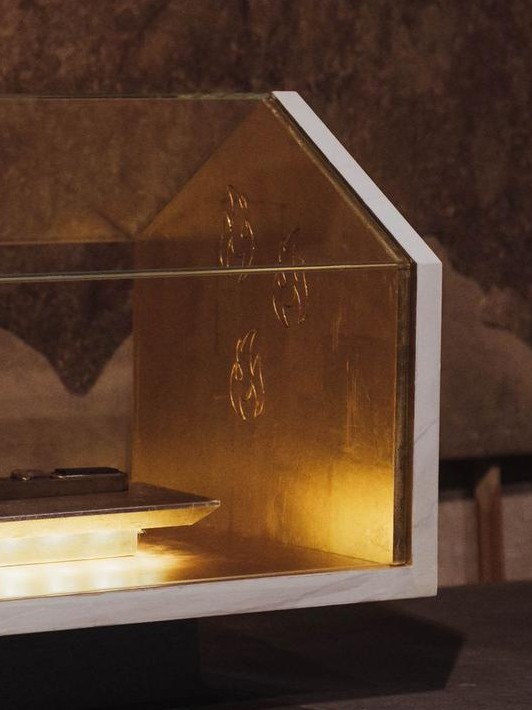
The final reliquary case will be placed in the Altoviti Chapel, the first on the left upon entering the Church of Saints Apostles, where the papier-mâché crucifix recovered after the flood has recently been reinstalled. The structure will be suspended above the pietra serena altar without touching it: a gesture that evokes elevation and brings memory and resurrection into dialogue.
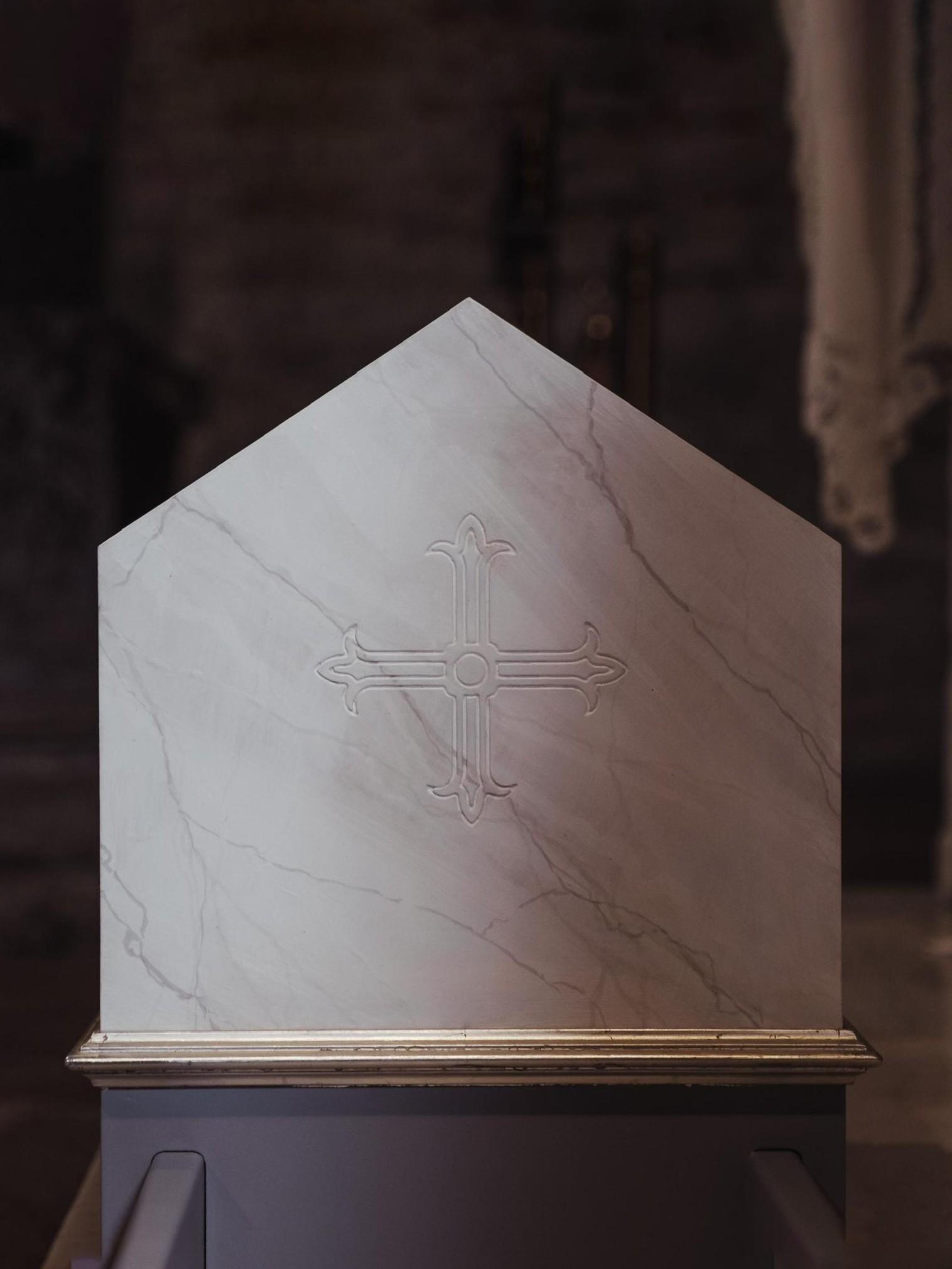
Alongside the fixed version, we have planned a lighter, mobile case in painted wood imitating marble, intended for the Holy Saturday procession. Inside it, a small support will maintain a symbolic distance between the source of the fire and the direct view of the stones. In the final model, the stones will be supported by a central pin, likely in gilded steel, aligned with the fleur-de-lis cross, a defining symbol of Florence.
The design follows golden proportions and incorporates iconographic motifs from the local tradition: Florentine fleur-de-lis crosses on the exterior, and three small flames on each side inside, symbolizing the Holy Spirit and reinterpreted from models of the school of Beato Angelico.
The project is currently under construction, with the aim of completing it by November, on the sixtieth anniversary of the 1966 flood.
On that occasion, we also envision a photographic exhibition with archival materials dedicated to the church inundated by mud and to its rebirth. A passage we feel deeply our own: having taken part in this project, both personally and professionally, means entering a living history—and returning it, with respect, to the city.